How printmaking changed who could own art
For most of history, owning a picture meant owning the only one. A painted altarpiece hung in one church; a portrait hung in one house. If you wanted to see a famous image, you traveled to it, or you saw a copy someone had painted by hand, slowly and expensively.
Printmaking broke that arrangement. Once an image could be cut into wood or metal and pressed onto paper dozens or hundreds of times, pictures became things that could travel, be sold cheaply, be pinned to a wall at home and be carried in a pocket. The question people sometimes ask, how did the use of printmaking change the world of art, has a simple answer at its core: it changed who could have art, and that in turn changed what artists made.
Before Europe: the woodblock
Relief printing from carved wooden blocks is far older in East Asia than in Europe. The oldest dated printed book that survives, a copy of the Diamond Sutra found at Dunhuang and now in the British Library, was printed in China in 868. Woodblock printing spread through China, Korea and Japan for religious texts, books and later images, centuries before it became common in Europe.
That long history matters later in this story, because Japanese woodblock prints would eventually reshape European art too.
Woodcuts and the first printed pictures in Europe
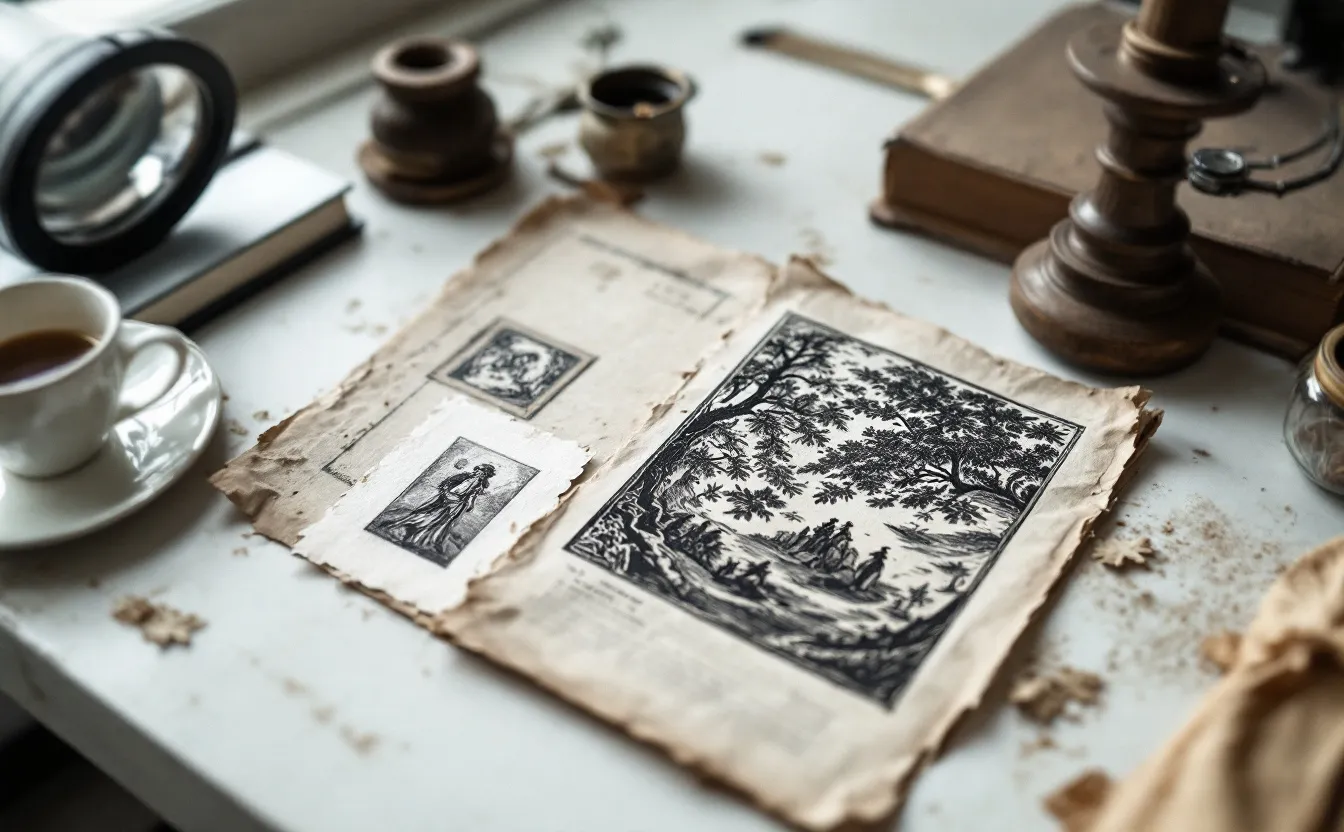
In Europe, printing images from woodblocks onto paper became widespread in the early fifteenth century, as paper itself became cheaper and more available. Early woodcuts were often devotional images of saints, sold at pilgrimage sites and fairs, sometimes hand-colored. One of the earliest dated examples, a Saint Christopher, carries the date 1423.
These were not luxury objects. They were made to be affordable, used, pasted inside chests and doors, and eventually worn out. That is one reason relatively few survive: they were loved to pieces.
When Johannes Gutenberg's movable-type press appeared in Mainz around the middle of the century, printed books and printed pictures grew together. Woodcuts could be locked into the same press as type, so illustrated books became possible on a scale no scriptorium could match.
Dürer: the artist as publisher
Albrecht Dürer, working in Nuremberg around 1500, is the figure who shows most clearly what prints could do for an artist. His woodcut series of the Apocalypse, published in 1498, and his engravings such as Melencolia I (1514) were sold across Europe. Prints carried his monogram and spread his reputation far beyond anywhere his paintings could reach.
Dürer was, in effect, his own publisher. He controlled the images, managed their sale and protected them as best he could from copyists. The idea that an artist could build a career and an income from multiples, not only from commissions, starts to look modern here.
Engraving, etching and the collector's print
Two metal techniques followed the woodcut. In engraving, the artist cuts lines into a copper plate with a sharp tool called a burin; ink is pushed into the lines, the surface is wiped and the plate is printed under heavy pressure. In etching, the artist draws through a waxy ground on the plate with a needle and lets acid bite the exposed lines, a freer, more drawing-like process.
Rembrandt, in seventeenth-century Amsterdam, made around three hundred etchings and reworked many plates through several "states", changing the image between printings. Collectors sought out the different states and impressions even in his lifetime. Prints had become collectible art in their own right, valued not only as copies of something else.
Engraving also served as the photocopier of its time. Reproductive engravers translated famous paintings into prints, which is how many people across Europe first saw works by Raphael or Rubens. Taste and knowledge of art traveled on paper.
Ukiyo-e: pictures of the floating world
In Edo-period Japan, color woodblock printing reached extraordinary refinement. Ukiyo-e prints showed actors, courtesans, landscapes and everyday scenes, made by a team: a designer, a carver, a printer and a publisher. They were sold at modest prices to townspeople, more like posters or magazines than treasures.
Katsushika Hokusai's Under the Wave off Kanagawa, from the series Thirty-six Views of Mount Fuji published in the early 1830s, is probably the most reproduced example. When Japanese prints began to arrive in Europe in quantity in the second half of the nineteenth century, artists including Vincent van Gogh, Edgar Degas and Mary Cassatt studied them closely. Their flat areas of color, bold outlines, unusual viewpoints and cropped compositions fed directly into new ways of picturing.
Lithography and the poster
Lithography, invented in Bavaria by Alois Senefelder in the 1790s, works on a completely different principle from relief or metal printing. The artist draws with a greasy crayon or ink on a flat stone or plate. The surface is treated so that the greasy marks attract ink and the wet, bare areas repel it. Because the artist simply draws, lithography captures the look of a crayon drawing or a wash directly.
By the late nineteenth century, color lithography made large, bright posters possible. In Paris, Henri de Toulouse-Lautrec's posters for cabarets and performers turned the city's walls into a public gallery. Art met advertising, and millions of people saw striking design every day without entering a museum.
Prints with a message
Because prints are cheap and multiple, they have long been a tool for argument as well as decoration. Francisco Goya's etchings, including the series later known as The Disasters of War, recorded atrocities in a medium that could circulate. In the twentieth century Käthe Kollwitz's woodcuts and lithographs addressed grief, poverty and war in images made to be seen widely. Relief printing in particular, simple and inexpensive, became a favored medium for political and community art in many countries.
The twentieth century: screenprints and editions
Screenprinting, which pushes ink through a fine mesh with a stencil, began as a commercial process and was adopted by artists in the mid-twentieth century. Andy Warhol's screenprints of the 1960s made repetition itself the subject: soup cans, celebrities and news images, each one slightly different, all from the same screen.
At the same time, the conventions that collectors now take for granted settled into place: the limited edition, numbered in pencil (12/50), signed by the artist, with artist's proofs set aside. These rules partly exist to restore scarcity to a medium whose original gift was abundance. A limited edition promises that the print you own is one of a known, finite number.
What it means at a kitchen table
All of this is close at hand for anyone who carves a block or rolls paint on a gel plate. The same choices early printmakers faced still apply: whether to make one image or many, whether to sell them cheaply or treat them as precious, whether the print is a copy of a drawing or something only a print can be.
If you want to try the oldest technique in the story, the note on linocut at home walks through carving and printing a first block by hand. If you want the most spontaneous one, try monotypes on a gel plate. Other notes on reading and enjoying art on paper are under looking at art.
How to look at a print
Knowing a little history changes how you look at a print in a museum or a shop. A few things are worth checking. First, the technique: woodcut lines tend to be bold and slightly irregular, engraving lines swell and taper cleanly, etching lines look freer and more like drawing, and lithographs often show the grain of a crayon. Second, the impression: an early impression from a fresh plate or block is crisp, while a late one can look worn, with lines thickened or broken. Third, the margins: plate marks, pencil numbers and signatures say a lot about how and when a print was made.
None of this needs expert knowledge, only time and a little patience. Many museum websites let you zoom in close enough to see these details at home.
Questions people ask
Is a print a "real" work of art?
An original print, one the artist designed for printmaking and made or supervised, is an original work, even though several impressions exist. That is different from a reproduction, which is a photographic or digital copy of a painting.
Why are some old prints worth so much?
Rarity, condition, the quality of the impression and the state of the plate all matter. An early, crisp impression of a famous print in good condition can be very valuable; a late, worn impression of the same image may be worth far less.
Where can I see historic prints in person?
Many art museums have print rooms or study centers where you can ask to see works on paper by appointment. Large museums also publish their print collections online with detailed photographs.