Sketchbook ideas that turn into a habit
A few links on this page go to art supplies we describe. As an Amazon Associate I earn from qualifying purchases.
Lists of sketchbook ideas usually fail for the same reason New Year's resolutions do. They are full of exciting prompts ("draw your dream city", "a dragon made of teacups") that are fun once and impossible to repeat. A habit does not grow from novelty. It grows from small, ordinary things you can do again tomorrow without having to think.
The ideas below are chosen for repeatability. Most of them can be done in ten minutes, at a table, with one pencil. Several are deliberately boring, because boring subjects are the ones that make you look harder.
Start smaller than feels reasonable
The commonest reason a sketchbook stalls is ambition. You open a new book, feel you owe it something impressive, and spend forty minutes on a drawing you then dislike. The next day the book feels heavy.
Set a floor instead of a target: one small drawing, any quality, most days. Ten minutes. If you want to do more, do more, but the floor is all that counts. On a bad day, three lines of a cup on the table still count.
A timer helps. Setting ten minutes makes it easier to start (it is only ten minutes) and easier to stop without guilt.
Forty repeatable prompts
These are grouped by what they teach. Repeat any of them as often as you like. Repeating is the point.
Things on the table
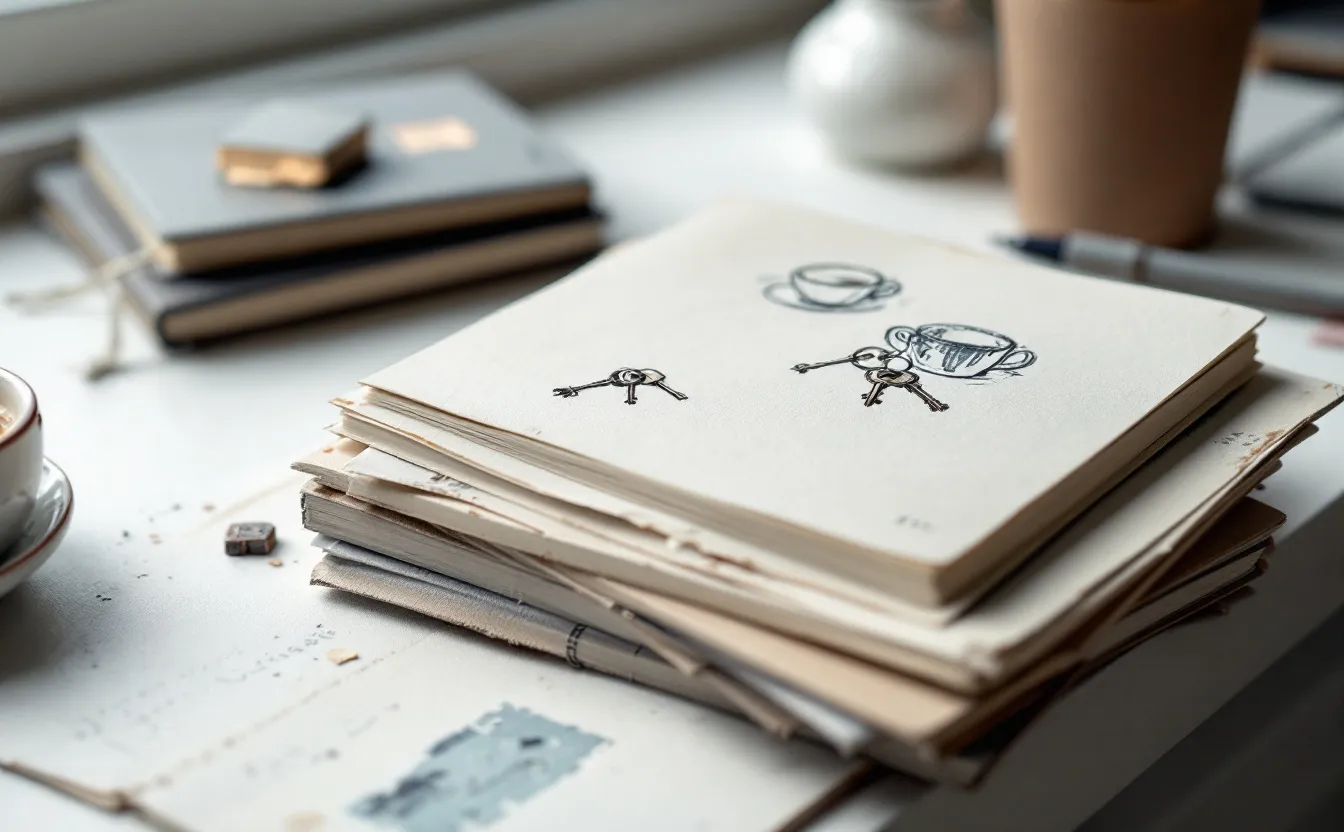
- Your coffee mug, from a different side each day.
- A bunch of keys, dropped and drawn where they land.
- A fork, a spoon and a knife together.
- The same apple every day for a week as it wrinkles.
- A crumpled receipt.
- Your shoes, as you took them off.
- A pair of scissors, open.
- A glass of water, with the window seen through it.
- Folded laundry.
- Whatever is in your bag, tipped out.
Hands and people
- Your non-drawing hand, holding something.
- Your non-drawing hand, doing nothing.
- People waiting: a bus stop, a café, a queue, in thirty-second gestures.
- Someone reading, while they are absorbed.
- A self-portrait in a spoon.
Places
- The view from one window, once a week, all year.
- The corner of a room, including the clutter.
- Your street at the same time of day.
- A doorway.
- A plant on a windowsill as it grows.
Seeing, not things
- Only shadows: draw the shapes of shadows on the table and ignore the objects.
- Only edges: a contour drawing without lifting the pencil.
- Blind contour: draw without looking at the page.
- Negative space: draw the gaps between chair legs.
- Values only: three tones, no lines.
- One object, five sizes on one page.
- Draw something with your eyes half closed, recording only big shapes.
- Draw the same object with your opposite hand.
- Twelve tiny thumbnails of one scene, each a different composition.
- Draw for one minute, turn the page, draw for one minute again.
Materials
- A page of pencil marks from your hardest to your softest grade.
- A wash swatch page: every color you own, light to dark.
- Draw in ink with no pencil first.
- Draw with a stick dipped in ink.
- Fill a page with textures: wood, fabric, stone, fur.
- Collage a page from a receipt or a bus ticket, then draw over it.
- Draw on a colored page with white and black only.
- A single object in three media on one spread.
- Copy a master drawing from a museum's online collection, slowly.
- Redraw your favorite page from last month.
If you are unsure which pencils to use for the tonal prompts, the note on drawing pencil grades explains what each grade does.
A ten-minute routine
Structure removes decisions, and decisions are what kill habits. A simple routine might look like this:
| Minutes | What to do |
|---|---|
| 0 to 1 | Write the date and the place at the top of the page |
| 1 to 3 | Three quick gesture drawings of anything nearby |
| 3 to 9 | One longer drawing of one object or view |
| 9 to 10 | One line of words: what you noticed, what went wrong |
That last line matters more than it looks. A note such as "handle too thick again" or "shadow under the cup is darker than the cup" is how you notice patterns and improve.
Getting past the blank page
Fear of spoiling a clean page is real. Some ways around it:
- Ruin the first page deliberately. A swatch test, a scribble, coffee rings: anything that makes the book yours.
- Tone a few pages in advance with a light wash or a pencil scribble rubbed with tissue. A page that is already marked is less intimidating.
- Divide pages into boxes before you start, so you only have to fill a small rectangle.
- Keep a list of ten default subjects inside the front cover. When you do not know what to draw, draw number one.
- Allow bad drawings. Everyone who fills sketchbooks fills them mostly with ordinary pages. The good ones are good because of the ordinary ones around them.
Choosing a book you will actually use
The book itself can help or hinder. A small, inexpensive book that fits in a pocket is easier to use daily than a beautiful large one that feels too good to spoil. Paper heavy enough for a light wash widens what you can try. The note on picking a mixed media sketchbook goes through weights, bindings and a first-page test.
Some people keep two books: a tiny one for daily ten-minute drawings and a larger one for slower studies at home. Both count.
Keeping going after the first week
The first week is easy; enthusiasm carries it. The third and fourth weeks are where most sketchbooks stop. A few things help:
- Leave the book open on the table where you eat breakfast or drink tea.
- Attach drawing to something you already do daily: the first coffee, the train, the ten minutes before dinner.
- Track the days on the inside cover with a simple tally. A visible streak is motivating, and breaking it once is not a reason to stop.
- Look back through old pages once a month. Progress is invisible day to day and obvious over months.
- Repeat a drawing from your first week at the end of your second month. Compare them side by side.
When a book is full, write the date range on its spine and start the next one the same day. A shelf of filled books is the best evidence there is that a habit has formed. Other notes on routines and small-space making are under studio habits.
When a prompt stops working
Sooner or later, even a good prompt goes stale. When drawing the mug every morning starts to feel automatic, change one variable and keep the rest. Draw it from above. Draw it in ink with no pencil first. Draw only its shadow, or only its reflection in a spoon. Give yourself two minutes instead of ten, or forty minutes on a weekend. Small changes keep the habit while waking up the eye.
It also helps to borrow structure from other people. Some artists follow monthly drawing challenges, sketch with a friend over video, or join a local sketching group that meets in a library or a park. The social element makes it easier to turn up on days when motivation is low.
A change of material can do the same job. Swap the pencil for a ballpoint for a week, or a brush pen, or a single color of watercolor. Each tool forces different decisions: a pen cannot be erased, a brush cannot make a thin line without care, a single color makes you think in values.
Finally, notice which prompts you return to without being asked. Those are clues to what you actually enjoy drawing, and they are worth following further.
Questions people ask
How long should a daily sketch take?
As long as you can reliably manage. Ten minutes most days beats an hour once a week. Longer sessions can come when you have the time.
Should I draw from photos?
From life whenever you can, because seeing a real object in space teaches you more. Photos are useful for subjects that will not hold still, and copying master drawings from museum collections is a long-standing way to learn.
What if I miss days?
Pick up the next day without trying to catch up. A habit survives gaps; it does not survive guilt.