Drawing pencils: what the grades mean and which ones to own
A few links on this page go to art supplies we describe. As an Amazon Associate I earn from qualifying purchases.
A tin of drawing pencils looks like a promise. Twelve or twenty identical sticks, each stamped with a mysterious code, from 9H at one end to 9B at the other. Most people who buy one use three of them, sharpen the 2B down to a stub and leave the rest untouched. That is not a failure. It is the system working: the grades exist so that you can find the few that suit your hand, your paper and the drawings you like to make.
This note explains what the letters and numbers mean, what actually changes from grade to grade, and how to build a small set that does almost everything.
What the letters stand for
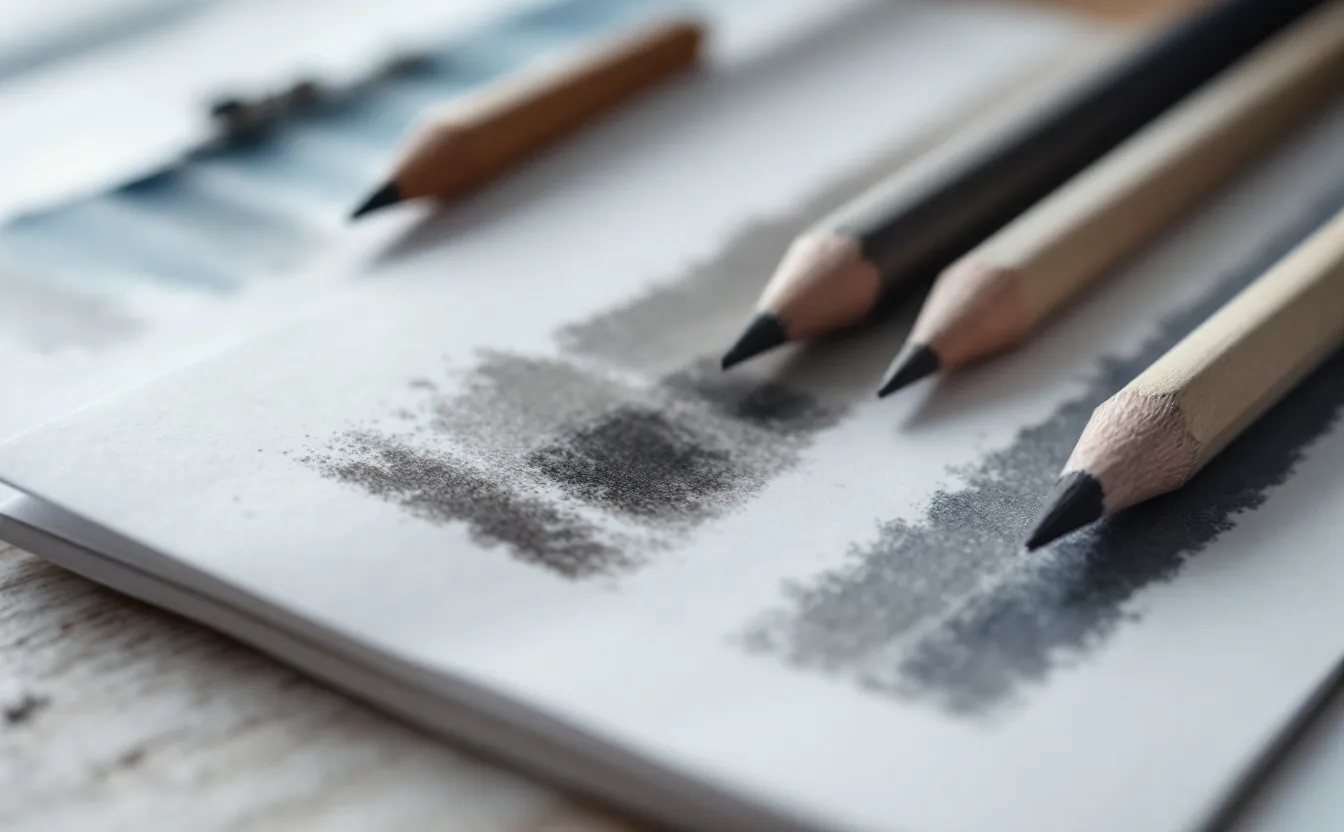
A graphite pencil "lead" is not lead at all. It is a fired mixture of graphite and clay. More clay makes a harder core that leaves a lighter, finer line. More graphite makes a softer core that leaves a darker, broader line and wears down faster.
Manufacturers label that hardness with letters and numbers:
- H stands for hard. The higher the number, the harder and paler: 2H is moderately hard, 6H is very hard.
- B stands for black (and soft). The higher the number, the softer and darker: 2B is a soft writing pencil, 8B is very soft.
- HB sits in the middle, roughly where most writing pencils land.
- F (for fine, or firm) sits between HB and H, and turns up in some ranges.
The common American school pencil labeled "No. 2" is roughly equivalent to an HB, though numbering is not standardized and varies by maker.
That last point matters more than any chart: grades are not consistent between brands. One company's 4B can be darker than another's 6B. If you mix pencils from different makers, test each one on a strip of your paper before trusting the label.
How the grades behave on paper
| Grade range | Typical feel | Line | Good for | Watch out for |
|---|---|---|---|---|
| 6H-4H | Very hard, scratchy | Pale, sharp, hard to erase if pressed | Light construction lines under watercolor, technical work | Dents the paper; dents show up when you shade over them later |
| 3H-H | Hard | Light gray, clean | Initial layout, fine textures, light tones | Shiny if layered heavily |
| F-HB | Medium | Mid gray | Sketching, writing, middle tones | Can look flat in darks |
| 2B-4B | Soft | Dark, smooth | Most drawing, shading, expressive lines | Smudges; needs a light hand in pale areas |
| 6B-9B | Very soft, crumbly | Very dark, broad | Deep shadows, bold sketches | Smears easily, wears fast, can shine |
Two effects surprise people. The first is shine. Graphite is a crystalline material, and when you press hard or layer a lot of it, especially with harder grades, the surface turns metallic and reflective. Under a lamp, your deepest shadow can look lighter than a moderate tone because it bounces light back. Softer grades applied with lighter pressure give a darker, more matte black than a hard pencil pushed hard.
The second is the dent. A hard pencil under pressure embosses a groove into the paper. Later, when you shade softly over that area, the groove stays white, like a ghost line. That is a useful trick for drawing white hairs or the veins in a leaf, and an annoying one if it happens by accident. Keep hard pencils light.
Paper changes everything
The same pencil behaves differently on different papers. A smooth bristol takes graphite in a fine, even film, which suits detailed, polished work. A drawing paper with a little tooth grabs more graphite from each stroke, so softer grades look darker and shading builds faster. A rough paper shows its texture through any tone, which can be beautiful in a loose sketch and distracting in a portrait.
Before deciding that a pencil is "too pale" or "too smudgy", try it on another paper. Many complaints about pencils are really complaints about smooth copy paper. A heavyweight sketch or mixed media paper gives most grades enough grip to show what they can do; the note on mixed media sketchbooks covers that kind of paper in more detail.
A small set that covers almost everything
You do not need twenty grades. For most drawing, four or five pencils are enough:
- 2H for light construction lines you plan to draw over or erase.
- HB for general sketching and middle tones.
- 2B for most shading and confident lines.
- 4B for darker shadows.
- 6B or 8B for the darkest accents, used sparingly.
That set gives you a full range of values without much overlap. If you are not sure which brand you prefer, a tin of artist graphite pencils across the grades is a cheap way to try them all once. After a few weeks, notice which ones you reach for, then buy those as singles.
Add three small tools and the kit is complete:
- A kneaded eraser, which lifts graphite by dabbing rather than rubbing and can be shaped to a point for highlights.
- A plastic or vinyl eraser for clean, decisive corrections.
- A craft knife and a sanding pad, or a good sharpener. Many artists sharpen with a knife to expose a long point that can be used on its side for broad tone.
Drawing a value scale
The best way to learn your pencils is to make a value scale. Draw a row of seven or nine small boxes. Leave the first one white. Fill the last one as dark as you can manage, using your softest pencil. Then fill the boxes in between so each step is evenly darker than the one before.
Do it twice: once using only one pencil, an HB or 2B, and changing pressure; then again switching pencils from hard to soft with steady, light pressure. The first scale teaches you pressure control. The second teaches you what each grade can do on its own. Pin both above your table. Whenever a drawing looks flat, compare its darkest and lightest areas to the scale; usually the darks are not dark enough.
Holding and layering
How you hold the pencil matters as much as which one you pick. Holding it near the tip, like a pen, gives control for detail. Holding it further back, with the pencil lying more on its side, gives lighter, broader strokes and keeps you from pressing too hard. Many people shade with the side of a long-sharpened point for smooth tone, then switch to the tip for edges and accents.
Build tone in layers rather than in one heavy pass. Several light layers of a 2B, crossing in slightly different directions, look richer than one dense layer pressed into the paper. Save the softest grades for last; once a very soft layer is down, it is hard to work into it with anything harder.
Blending tools (paper stumps, tissues, fingers) can smooth tones, but they also push graphite into the paper's tooth and make it harder to erase. Use them deliberately, not by habit. A drawing that keeps its pencil marks often looks livelier than one blended to a gray mist.
Keeping drawings clean
Soft graphite smudges. Rest your drawing hand on a scrap sheet of paper rather than on the drawing itself, and work from top to bottom and from the side away from your drawing hand. If you want to protect finished drawings, a workable fixative sprayed in light coats outdoors or in a well-ventilated room reduces smudging. Many artists skip fixative and simply store drawings flat with a sheet of tissue on top; the note on storing drawings and prints explains how.
Questions people ask
What is the best pencil grade for beginners?
There is no single best grade, but an HB and a 2B together cover most early drawing. Add a 4B when you start shading in earnest.
Why does my dark shading look shiny?
Too much pressure or too many layers of a hard grade. Switch to a softer pencil and lighter pressure for darks, and draw on paper with a little tooth.
Are mechanical pencils good for drawing?
Yes, for fine lines and detail. Leads come in several grades too, commonly from 2H to 4B. They are less suited to broad shading because the lead is thin.
Do I need a separate set of charcoal pencils?
Not at first. Charcoal gives a deeper, more matte black than graphite and handles very differently. It is worth trying once your graphite drawings feel comfortable; more drawing notes are collected under drawing.