Storing drawings and prints flat at home
Most drawings are not lost to fire or flood. They are lost slowly, in a cardboard tube in a closet, in a sketchbook left on a windowsill, in a stack of sheets under a bed where the top one rubs the drawing below it into a gray haze. Works on paper are robust in some ways and fragile in others, and the fragile part is almost always the surface.
Good storage is not expensive, and it does not need a conservation lab. It needs a few materials that do not harm paper, a place in the house where conditions stay steady, and a habit of putting finished work away properly instead of leaving it on the table.
What damages paper
Knowing the enemies makes the rest obvious.
| Threat | What it does | How storage helps |
|---|---|---|
| Abrasion | Rubs graphite, charcoal and pastel off, smears soft media onto neighbors | Interleaving sheets, folders, storing flat so sheets do not slide |
| Light | Fades many pigments and inks, yellows some papers | Closed boxes and drawers |
| Acid | Yellows and weakens paper from cheap boards, folders and wood | Acid-free and lignin-free materials |
| Humidity swings | Cockling, curling, mold above roughly 65% relative humidity | A stable room, not a basement or attic |
| Heat | Speeds up chemical aging | Away from radiators, ovens, sunny walls |
| Pests | Silverfish and others eat paper and sizing | Closed boxes, clean storage, regular checks |
| Handling | Creases, fingerprints, tears | Supports when moving sheets, clean dry hands |
Conservation guidance from museums and bodies such as the American Institute for Conservation repeats the same few principles: keep paper flat or supported, keep it in the dark, keep it in stable, moderate conditions, and keep it in contact only with materials that will not harm it.
Flat is better than rolled
Rolling seems efficient, and tubes are fine for shipping, but rolled paper wants to stay rolled. Flattening a sheet that has lived in a tube for years can crack media and strain fibers, and charcoal or pastel on a rolled drawing rubs against the back of the same sheet with every turn.
Store finished work flat whenever you can. If a large sheet really has to be rolled, roll it image side out around a wide tube (at least 4 inches across), with a sheet of tissue over the image, and wrap the outside in paper.
Interleaving: the cheapest protection there is
Interleaving means placing a sheet of protective paper between each piece of work. It stops the surface of one drawing from rubbing against the back of the next, and it stops soft media transferring.
For most drawings, prints and watercolors, plain acid-free tissue or glassine works well. Glassine is smooth and slightly translucent, so you can see the work beneath it. Some conservators advise against glassine for pastel and charcoal, because its smooth surface can pick up loose particles or build static; for very powdery work, a soft unbuffered tissue laid gently on top is the usual recommendation, and such pieces are better kept in a box with very little weight on them.
Cut interleaving sheets a little larger than the work, so the edges are covered.
Folders, boxes and drawers
The next layer is a container.
- Folders made from acid-free card hold small groups of sheets and make it easy to lift several together without touching any one of them.
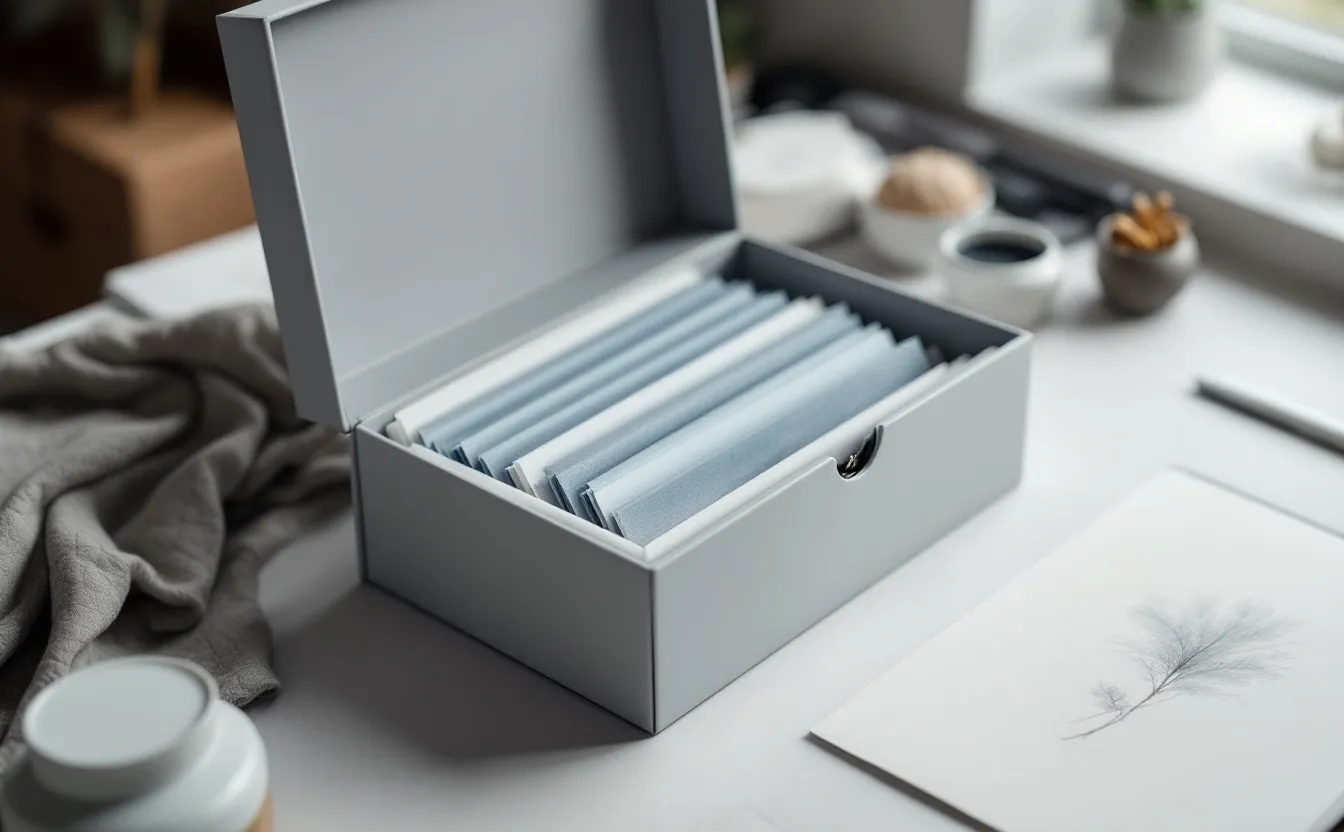
- Archival boxes, especially the drop-front or clamshell type, keep out light and dust and protect against small knocks. Buy the size that fits your largest common sheet; a half-empty box lets work slide around, so fill the gap with clean folded card.
- Flat file drawers are ideal for larger collections and full sheets, if you have the room. Line wooden drawers with acid-free board, since wood gives off acids over time.
- Portfolios with clear sleeves are fine for presenting work, but choose sleeves made from archival polyester (often sold as Mylar or Melinex), polypropylene or polyethylene, not PVC, which can give off harmful compounds. Never put pastel or charcoal in a plastic sleeve; static pulls the pigment off the paper.
Look for the words acid-free and lignin-free on folders and boxes. "Buffered" materials contain an alkaline reserve that neutralizes acids over time; they suit most papers. Some sources recommend unbuffered materials for certain photographs and sensitive works, which matters more for mixed collections than for a drawer of graphite sketches.
Where in the house
The ideal is the place where you are comfortable: around room temperature, relative humidity somewhere in the middle range (conservators often quote roughly 35 to 55 percent), and no big daily swings. In most homes that means an interior closet or a drawer in a living space.
The worst places are the ones people use most often for storage: basements (damp, mold, floods), attics (heat swings), garages, the wall shared with a bathroom, the space under a sunny window and anywhere against an outside wall. If you can only use a basement, raise boxes off the floor on shelves and check them every few months.
Handling
Most damage happens while moving work. A few habits prevent it:
- Wash and dry your hands before handling finished work. Lotion and skin oils leave marks that darken over time. Clean cotton or nitrile gloves are an option, though many conservators prefer clean bare hands for paper because gloves reduce grip.
- Move sheets on a support: a piece of mat board or stiff card slid underneath, never by one corner.
- Lift interleaving tissue off by its edges, not by sliding it across a drawing.
- Keep drinks, glue and food somewhere else entirely.
Labeling and records
Write labels in soft pencil on the back of a work, near a corner, pressing lightly so the marks do not emboss through. Never use ballpoint or marker on the back of paper you care about; they can bleed through over time. Label folders and boxes on the outside.
A simple list, kept in a notebook or a file, saves a great deal of rummaging: title or subject, date, medium, paper, size and which box it lives in. If you sell or give work away, add who has it.
Sketchbooks
Sketchbooks are their own small archive. Store them upright on a shelf like books, not stacked in a pile where the bottom ones are crushed, and away from sunlight that fades spines and edges. For books full of charcoal or soft pastel, slip a sheet of tissue between heavily worked pages. A fixative can help, though many artists prefer not to change the surface; the note on drawing pencil grades explains why graphite smudges and how to draw in a way that smudges less.
Watercolors and cockled sheets
Watercolors that dried with gentle waves can usually be flattened before storage: lightly mist the back with clean water, sandwich the sheet between clean blotting papers and boards, and leave it under even weight for a day or two. Do not do this with gouache passages, which can lift, or with work you are not willing to risk. The note on choosing watercolor paper covers why some papers cockle more than others in the first place. Other notes on keeping work in good condition are under framing and care.
A simple setup for a small collection
For someone with a few dozen drawings and prints, a practical setup looks like this. One or two archival boxes sized to your most common sheet, perhaps 11 by 14 inches. A pack of acid-free tissue cut slightly larger than the box. A few acid-free folders to group work by year or medium. A pencil list inside the lid of each box. The boxes live on a shelf in a bedroom or living room closet, not on the floor.
Larger sheets can go between two pieces of acid-free mat board taped into a simple folder, slid flat under a bed or behind a bookcase, as long as that spot stays dry and away from heating vents. Once a year, open each box, check for any sign of insects or damp, and replace any tissue that has become creased or dirty. That single annual check catches most problems while they are still small.
Questions people ask
Is printer paper OK as interleaving?
Ordinary copy paper is often acidic and slightly abrasive. For short periods it is better than nothing; for long-term storage, use acid-free tissue or glassine.
Should I use fixative on everything?
No. Fixative reduces smudging on charcoal and soft graphite, but it can darken tones and changes the surface. Many artists use it lightly or not at all and rely on careful storage instead. If you do use it, spray in light coats outdoors or in a well-ventilated room.
Can I store framed and unframed work together?
Store framed work upright, like books, with corners protected, and unframed work flat in boxes. Mixing them in one stack risks frames denting the paper.